Hi, guys this is Ujjwal Kumar Sen (Join My YouTube Channel for SSB JE 2026 Classes: https://www.youtube.com/ujjwalkumarsen), today in this article I am going to share with you list of all books those are really going to help you to get good marks in the exam so that you can get your dream job in dream department of Indian Railway as well as syllabus of all branches (Mechanical, Electrical, Civil, Quantity Surveying and Contracts, CSE, ECE, Physics), preparation strategy to crack and get job, marks distribution for Paper- 1 and Paper- 2.
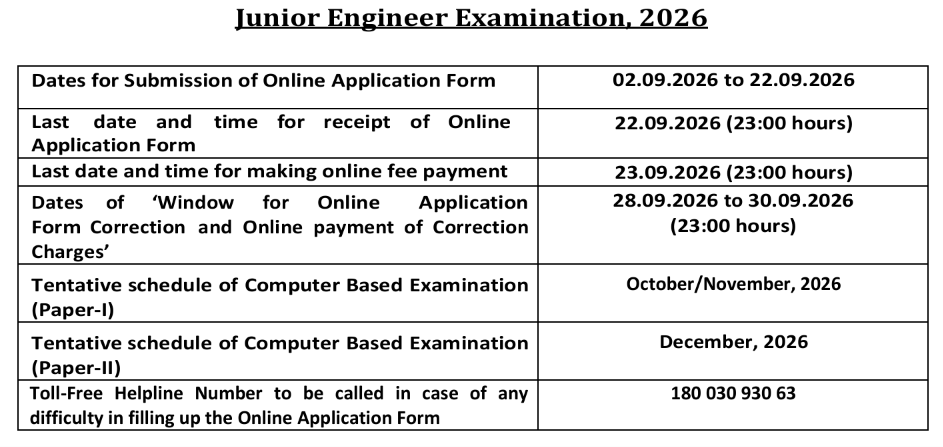
SSC JE Online Application Dates and Exam Details-
Join Telegram Channel- Click Here
Best Test Series for SSC JE 299 Rs only Limited Time Offer-
✅Best Mechanical SSC JE Test Series Click Here to Get It
✅Best Electrical SSC JE Test Series Click Here to Get It
✅Best Civil SSC JE Test Series Click Here to Get It
SSC JE 2026 Eligibility Criteria-
|
Organization |
Post |
Educational Qualification |
Age Limit |
|
Border Roads Organisation (BRO) |
JE Civil |
Degree in Civil Engineering OR 3-year Diploma in Civil Engineering + 2 years experience in Planning/Execution/Maintenance of Civil Engineering works |
30 years |
|
BRO |
JE Electrical & Mechanical |
Degree in Electrical/Mechanical Engineering OR 3-year Diploma in Electrical/Automobile/Mechanical Engineering + 2 years experience in Planning/Execution/Maintenance |
30 years |
|
Brahmaputra Board, Ministry of Jal Shakti |
JE Civil |
3-year Diploma in Civil Engineering |
30 years |
|
Central Water Commission (CWC) |
JE Mechanical |
Bachelor’s Degree OR Diploma in Mechanical Engineering |
30 years |
|
CWC |
JE Civil |
Bachelor’s Degree OR Diploma in Civil Engineering |
30 years |
|
CPWD |
JE Electrical |
Diploma in Electrical or Mechanical Engineering |
32 years |
|
CPWD |
JE Civil |
Diploma in Civil Engineering |
32 years |
|
Central Water & Power Research Station (CWPRS) |
JE Electrical |
Diploma in Electrical Engineering |
30 years |
|
CWPRS |
JE Civil |
Diploma in Civil Engineering |
30 years |
|
DGQA-NAVAL, Ministry of Defence |
JE Mechanical |
Degree in Mechanical Engineering OR 3-year Diploma + 2 years experience in respective field |
30 years |
|
DGQA-NAVAL |
JE Electrical |
Degree in Electrical Engineering OR 3-year Diploma + 2 years experience in respective field |
30 years |
|
Farakka Barrage Project, Ministry of Jal Shakti |
JE Electrical |
Diploma in Electrical Engineering |
30 years |
|
Farakka Barrage Project |
JE Civil |
Diploma in Civil Engineering |
30 years |
|
Military Engineer Services (MES) |
JE Civil |
Degree in Civil Engineering OR 3-year Diploma + 2 years experience in Planning/Execution/Maintenance |
30 years |
|
MES |
JE Electrical & Mechanical |
Degree in Electrical/Mechanical Engineering OR 3-year Diploma + 2 years experience in Planning/Execution/Maintenance |
30 years |
|
NTRO |
JE Civil |
Diploma in Civil Engineering |
30 years |
|
Directorate General of Lighthouses & Lightships |
JE Civil |
Degree in Civil Engineering OR Diploma in Civil Engineering + 3 years experience OR equivalent qualification |
32 years |
|
Directorate General of Lighthouses & Lightships |
JE Electrical |
Degree in Electrical Engineering OR Diploma in Electrical Engineering + 3 years experience OR equivalent qualification |
32 years |
|
Department of Telecommunications (DoT) |
JE Telecom |
Bachelor’s Degree in Engineering/Technology in Electrical, Electronics, Electrical Communications, Computer Science, Telecommunications, IT, Instrumentation, etc. |
30 years |
|
India Meteorological Department (IMD) |
Scientific Assistant |
B.Sc. with Physics as one subject OR Bachelor’s Degree in Computer Science/Computer Applications/Electronics/ECE/Electronics Telecommunication Engineering/related specified disciplines |
30 years |
|
Ministry of Fisheries, Animal Husbandry & Dairying |
JE Civil |
Degree OR 3-year Diploma in Civil Engineering |
30 years |
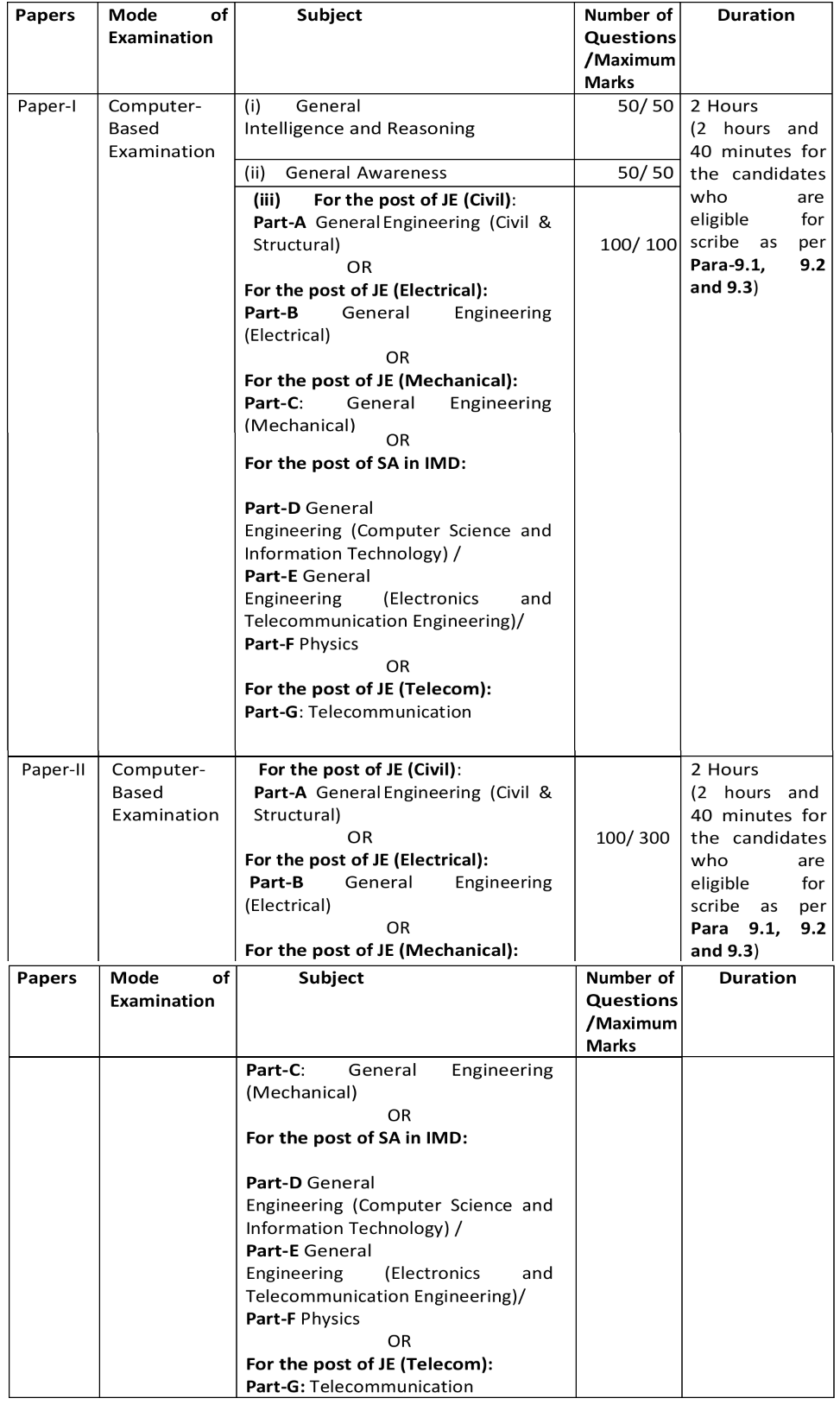
SSC JE 2026 New Exam Pattern-
SSC JE 2026 Branch Wise Vacancies-
Coming soon!
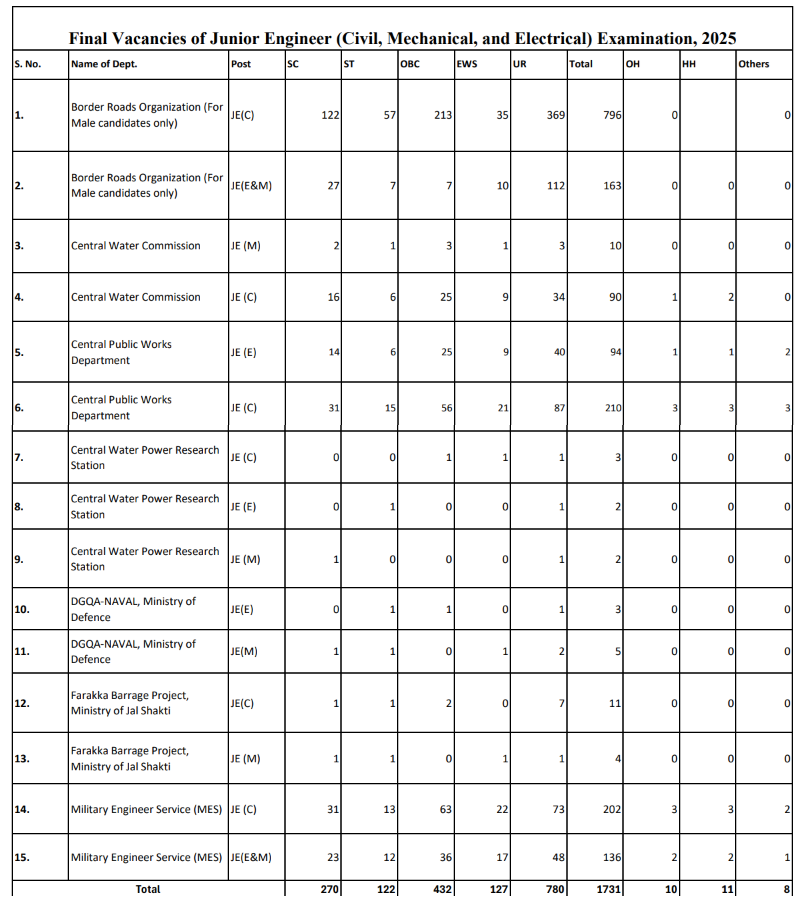
SSC JE 2025 Branch Wise Vacancies-
SSC JE 2024 Branch Wise Vacancies-

Paper- 1 Syllabus and Books:
✅Civil PYQ- PYQ Book
✅Mechanical PYQ- Volume 1 Link & Volume 2 Link
✅Electrical PYQ- SSC JE Previous Year Paper with Solution
Mechanical Hand Book- Link
Electrical Hand Book- Link
Civil Hand Book- Link
ECE Hand Book- Link
CSE Hand Book- Link
General Intelligence & Reasoning:
The Syllabus for General Intelligence would include questions of both verbal and non-verbal type. The test may include questions on analogies, similarities, differences, space visualization, problem solving, analysis, judgment, decision making, visual memory, discrimination, observation, relationship concepts, arithmetical reasoning, verbal and figure classification, arithmetical number series, etc. The test will also include questions designed to test the candidate’s abilities to deal with abstract ideas and symbols and their relationships, arithmetical computations and other analytical functions.
Recommended Books-
General Awareness:
Questions will be aimed at testing the candidate’s general awareness of the environment around him/ her and its application to society. Questions will also be designed to test knowledge of current events and of such matters of everyday observations and experience in their scientific aspect as may be expected of any educated person. The test will also include questions relating to India and its neighboring countries especially pertaining to History, Culture, Geography, Economic Scene, General Polity and Scientific Research, etc. These questions will be such that they do not require a special study of any discipline.
Recommended Books-
Part-A (Civil Engineering):
Building Materials, Estimating, Costing and Valuation, Surveying, Soil Mechanics, Hydraulics, Irrigation Engineering, Transportation Engineering, Environmental Engineering. Structural Engineering: Theory of Structures, Concrete Technology, RCC Design, Steel Design
Part-B (Electrical Engineering):
Basic concepts, Circuit law, Magnetic Circuit, AC Fundamentals, Measurement and Measuring instruments, Electrical Machines, Fractional Kilowatt Motors and single phase induction Motors, Synchronous Machines, Generation, Transmission and Distribution, Estimation and Costing, Utilization and Electrical Energy, Basic Electronics.
Part-C Mechanical Engineering):
Theory of Machines and Machine Design, Engineering Mechanics and Strength of Materials, 15 Properties of Pure Substances, 1st Law of Thermodynamics, 2nd Law of Thermodynamics, Air standard Cycles for IC Engines, IC Engine Performance, IC Engines Combustion, IC Engine Cooling & Lubrication, Rankine cycle of System, Boilers, Classification, Specification, Fitting & Accessories, Air Compressors & their cycles, Refrigeration cycles, Principle of Refrigeration Plant, Nozzles & Steam Turbines. Properties & Classification of Fluids, Fluid Statics, Measurement of Fluid Pressure, Fluid kinematics, Dynamics of Ideal fluids, Measurement of Flow rate, basic principles, Hydraulic Turbines, Centrifugal Pumps, Classification of steel.
Part-D (Computer Science and Information Technology)
Engineering Mathematics, Digital Logic, Computer Organization and Architecture, Programming and Data Structures, Algorithms, Theory of Computation, Compiler Design, Operating System, Databases, Computer Networks.
Part-E (Electronics and Telecommunication Engineering)
(A) Electronics: Electronic Materials & Components, Diodes, Transistors, Amplifiers
& Oscillators, Voltage Regulation, Introduction to Network Theorems, AC Circuits, Three-Phase Circuits, Resonance, Digital Electronics, Sequential & Combinational Logic and Data Conversion & Codes.
(B) Telecommunications: Antennas, Radio Wave Propagation, Electromagnetic Spectrum, Modulation, Single Sideband, Frequency Modulation, Pulse Modulation, Multiplexing, Introduction to Digital Communication and Radio Frequency Communications & Wireless Telecommunications.
Part-F (Physics)
Mathematical Methods, Mechanics, General Properties of Matter, Oscillations, Waves, Optics, Electricity, Magnetism, Kinetic Theory, Thermodynamics, Modern Physics, Solid State Physics, Semiconductor Devices, Analog and Digital Electronics.
Part-G (Telecommunications)
Engineering Mathematics, Network Analysis, Signals and Systems, Electronic Devices, Analog Circuits, Digital Circuits, Control Systems, Analog Communications, Digital Communications, Electromagnetics.
Paper- 2 Syllabus & Books According to Subjective wise for SSC JE 2026
Part-A (Civil & Structural Engineering):
Building Materials : Physical and Chemical properties, classification, standard tests, uses and manufacture/ quarrying of materials e.g. building stones, silicate based materials, cement (Portland), asbestos products, timber and wood based products, laminates, bituminous materials, paints, varnishes.
Estimating, Costing and Valuation: estimate, glossary of technical terms, analysis of rates, methods and unit of measurement, Items of work – earthwork, Brick work (Modular & Traditional bricks), RCC work, Shuttering, Timber work, Painting, Flooring, Plastering, Boundary wall, Brick building, Water Tank, Septic tank, Bar bending schedule, Centre line method, Mid-section formula, Trapezodial formula, Simpson‟s rule, Cost estimate of Septic tank, flexible pavements, Tube well, isolates and combined footings, Steel Truss, Piles and pile-caps. Valuation – Value and cost, scrap value, salvage value, assessed value, sinking fund, depreciation and obsolescence, methods of valuation.
Surveying : Principles of surveying, measurement of distance, chain surveying, working of prismatic compass, compass traversing, bearings, local attraction, plane table surveying, theodolite traversing, adjustment of theodolite, Levelling, Definition of terms used in levelling, contouring, curvature and refraction corrections, temporary and permanent adjustments of dumpy level, methods of contouring, uses of contour map, tachometric survey, curve setting, earth work calculation, advanced surveying equipment
Soil Mechanics : Origin of soil, phase diagram, Definitions-void ratio, porosity, degree of saturation, water content, specific gravity of soil grains, unit weights, density index and interrelationship of different parameters, Grain size distribution curves and their uses Index properties of soils, Atterberg‟s limits, ISI soil classification and plasticity chart Permeability of soil, coefficient of permeability, determination of coefficient of permeability, Unconfined and confined aquifers, effective stress, quick sand, consolidation of soils, Principles of consolidation, degree of consolidation, pre-consolidation pressure, normally consolidated soil, e-log p curve, computation of ultimate settlement Shear strength of soils, direct shear test, Vane shear test, Triaxial test Soil compaction, Laboratory compaction test, Maximum dry density and optimum moisture content, earth pressure theories, active and passive earth pressures, Bearing capacity of soils, plate load test, standard penetration test
Hydraulics : Fluid properties, hydrostatics, measurements of flow, Bernoulli‟s theorem and its application, flow through pipes, flow in open channels, weirs, flumes, spillways, pumps and turbines
Irrigation Engineering: Definition, necessity, benefits, 2II effects of irrigation, types and methods of irrigation, Hydrology – Measurement of rainfall, run off coefficient, rain gauge, losses from precipitation – evaporation, infiltration, etc Water requirement of crops, duty, delta and base period, Kharif and Rabi Crops, Command area, Time factor, Crop ratio, Overlap allowance, Irrigation efficiencies Different type of canals, types of canal irrigation, loss of water in canals Canal lining – types and advantages Shallow and deep to wells, yield from a well Weir and barrage, Failure of weirs and permeable foundation, Slit and Scour, Kennedy‟s theory of critical velocity Lacey‟s theory of uniform flow Definition of flood, causes and effects, methods of flood control, water logging, preventive measure Land reclamation, Characteristics of affecting fertility of soils, purposes, methods, description of land and reclamation processes Major irrigation projects in India
Transportation Engineering: Highway Engineering – cross sectional elements, geometric design, types of pavements, pavement materials – aggregates and bitumen, different tests, Design of flexible and rigid pavements – Water Bound Macadam (WBM) and Wet Mix Macadam (WMM), Gravel Road, Bituminous construction, Rigid pavement joint, pavement maintenance, Highway drainage, Railway Engineering- Components of permanent way – sleepers, ballast, fixtures and fastening, track geometry, points and crossings, track junction, stations and yards Traffic Engineering – Different traffic survey, speed-flow-density and their interrelationships, intersections and interchanges, traffic signals, traffic operation, traffic signs and markings, road safety
Environmental Engineering: Quality of water, source of water supply, purification of water, distribution of water, need of sanitation, sewerage systems, circular sewer, oval sewer, sewer appurtenances, sewage treatments Surface water drainage Solid waste management – types, effects, engineered management system Air pollution – pollutants, causes, effects, control Noise pollution – cause, health effects, control
Structural Engineering: Theory of structures: Elasticity constants, types of beams – determinate and indeterminate, bending moment and shear force diagrams of simply supported, cantilever and over hanging beams Moment of area and moment of inertia for rectangular & circular sections, bending moment and shear stress for tee, channel and compound sections, chimneys, dams and retaining walls, eccentric loads, slope deflection of simply supported and cantilever beams, critical load and columns, Torsion of circular section
Concrete Technology: Properties, Advantages and uses of concrete, cement aggregates, importance of water quality, water cement ratio, workability, mix design, storage, batching, mixing, placement, compaction, finishing and curing of concrete, quality control of concrete, hot weather and cold weather concreting, repair and maintenance of concrete structures
RCC Design: RCC beams-flexural strength, shear strength, bond strength, design of singly reinforced and double reinforced beams, cantilever beams T-beams, lintels One way and two way slabs, isolated footings Reinforced brick works, columns, staircases, retaining wall, water tanks (RCC design questions may be based on both Limit State and Working Stress methods) Steel Design: Steel design and construction of steel columns, beams roof trusses plate girders
Part-B (Electrical Engineering):
Basic concepts : Concepts of resistance, inductance, capacitance, and various factors affecting them Concepts of current, voltage, power, energy and their units
Circuit law : Kirchhoff‟s law, Simple Circuit solution using network theorems
Magnetic Circuit : Concepts of flux, mmf, reluctance, Different kinds of magnetic materials, Magnetic calculations for conductors of different configuration eg straight, circular, solenoidal, etc Electromagnetic induction, self and mutual induction
AC Fundamentals: Instantaneous, peak, RMS and average values of alternating waves, Representation of sinusoidal wave form, simple series and parallel AC Circuits consisting of RL and C, Resonance, Tank Circuit Poly Phase system – star and delta connection, 3 phase power, DC and sinusoidal response of R-Land R-C circuit
Measurement and measuring instruments: Measurement of power (1 phase and 3 phase, both active and re-active) and energy, 2 wattmeter method of 3 phase power measurement Measurement of frequency and phase angle Ammeter and voltmeter (both moving oil and moving iron type), extension of range wattmeter, Multimeters, Megger, Energy meter AC Bridges Use of CRO, Signal Generator, CT, PT and their uses Earth Fault detection
Electrical Machines : (a) DC Machine – Construction, Basic Principles of DC motors and generators, their characteristics, speed control and starting of DC Motors Method of braking motor, Losses and efficiency of DC Machines (b) 1 phase and 3 phase transformers – Construction, Principles of operation, equivalent circuit, voltage regulation, OC and SC Tests, Losses and efficiency Effect of voltage, frequency and wave form on losses Parallel operation of 1 phase /3 phase transformers Auto transformers (c) 3 phase induction motors, rotating magnetic field, principle of operation, equivalent circuit, torque-speed characteristics, starting and speed control of 3 phase induction motors Methods of braking, effect of voltage and frequency variation on torque speed characteristics Fractional Kilowatt Motors and Single Phase Induction Motors: Characteristics and applications
Synchronous Machines: Generation of 3-phase emf armature reaction, voltage regulation, parallel operation of two alternators, synchronizing, control of active and reactive power Starting and applications of synchronous motors
Generation, Transmission and Distribution: Different types of power stations, Load factor, diversity factor, demand factor, cost of generation, inter-connection of power stations Power factor improvement, various types of tariffs, types of faults, short circuit current for symmetrical faults Switchgears – rating of circuit breakers, Principles of arc extinction by oil and air, HRC Fuses, Protection against earth leakage / over current, etc Buchholtz relay, Merz-Price system of protection of generators & transformers, protection of feeders and bus bars Lightning arresters, various transmission and distribution system, comparison of conductor materials, efficiency of different system Cable – Different type of cables, cable rating and derating factor
Estimation and costing : Estimation of lighting scheme, electric installation of machines and relevant IE rules Earthing practices and IE Rules
Utilization of Electrical Energy : Illumination, Electric heating, Electric welding, Electroplating, Electric drives and motors
Basic Electronics : Working of various electronic devices eg P N Junction diodes, Transistors (NPN and PNP type), BJT and JFET Simple circuits using these devices.
Part- C (Mechanical Engineering):
Theory of Machines and Machine Design:
Concept of simple machine, Four bar linkage and link motion, Flywheels and fluctuation of energy, Power transmission by belts – V-belts and Flat belts, Clutches – Plate and Conical clutch, Gears – Type of gears, gear profile and gear ratio calculation, Governors – Principles and classification, Riveted joint, Cams, Bearings, Friction in collars and pivots
Engineering Mechanics and Strength of Materials:
Equilibrium of Forces, Law of motion, Friction, Concepts of stress and strain, Elastic limit and elastic constants, Bending moments and shear force diagram, Stress in composite bars, Torsion of circular shafts, Bucking of columns – Euler‟s and Rankin‟s theories, Thin walled pressure vessels Thermal Engineering
Properties of Pure Substances : p-v & P-T diagrams of pure substance like H2O, Introduction of steam table with respect to steam generation process; definition of saturation, wet & superheated status Definition of dryness fraction of steam, degree of superheat of steam H-s chart of steam (Mollier‟s Chart)
1 st Law of Thermodynamics : Definition of stored energy & internal energy, 1st Law of Thermodynamics of cyclic process, Non Flow Energy Equation, Flow Energy & Definition of Enthalpy, Conditions for Steady State Steady Flow; Steady State Steady Flow Energy Equation
2nd Law of Thermodynamics : Definition of Sink, Source Reservoir of Heat, Heat Engine, Heat Pump & Refrigerator; Thermal Efficiency of Heat Engines & co-efficient of performance of Refrigerators, Kelvin – Planck & Clausius Statements of 2nd Law of Thermodynamics, Absolute or Thermodynamic Scale of temperature, Clausius Integral, Entropy, Entropy change calculation of ideal gas processes Carnot Cycle & Carnot Efficiency, PMM-2; definition & itsimpossibility
Air standard Cycles for IC engines : Otto cycle; plot on P-V, T-S Planes; Thermal Efficiency, Diesel Cycle; Plot on P-V, T-S planes; Thermal efficiency IC Engine Performance, IC Engine Combustion, IC Engine Cooling & Lubrication
Rankine cycle of steam : Simple Rankine cycle plot on P-V, T-S, h-s planes, Rankine cycle efficiency with & without pump work Boilers; Classification; Specification;
Fittings & Accessories : Fire Tube & Water Tube Boilers Air Compressors & their cycles; Refrigeration cycles; Principle of a Refrigeraton Plant; Nozzles & Steam Turbines
Fluid Mechanics & Machinery
Properties & Classification of Fluid :
ideal & real fluids, Newton‟s law of viscosity, Newtonian and Non-Newtonian fluids, compressible and incompressible fluids
Fluid Statics: Pressure at a point
Measurement of Fluid Pressure: Manometers, U-tube, Inclined tube
Fluid Kinematics: Stream line, laminar & turbulent flow, external & internal flow, continuity equation
Dynamics of ideal fluids: Bernoulli‟s equation, Total head; Velocity head; Pressure head; Application of Bernoulli‟s equitation
Measurement of Flow rate Basic Principles: Venturimeter, Pilot tube, Orifice meter
Hydraulic Turbines: Classifications, Principles
Centrifugal Pumps: Classifications, Principles, Performance
Production Engineering
Classification of Steels : mild steal & alloy steel, Heat treatment of steel, Welding – Arc Welding, Gas Welding, Resistance Welding, Special Welding Techniques ie TIG, MIG, etc (Brazing & Soldering), Welding Defects & Testing; NDT, Foundry & Casting – methods, defects, different casting processes, Forging, Extrusion, etc, Metal cutting principles, cutting tools, Basic Principles of machining with (i) Lathe (ii) Milling (iii) Drilling (iv) Shaping (v) Grinding, Machines, tools & manufacturing processes
Part-D (Computer Science and Information Technology):
Engineering Mathematics:
Discrete Mathematics: Propositional and first-order logic. Sets, relations, functions, partial orders and lattices. Monoids, Groups. Graphs: connectivity, matching, colouring. Combinatorics:
counting, recurrence relations, generating functions.
Linear Algebra: Matrices, determinants, systems of linear equations, eigenvalues and eigenvectors, LU decomposition.
Calculus: Limits, continuity and differentiability, Maxima and minima, Mean value theorem, Integration.
Probability and Statistics: Random variables, Uniform, normal, exponential, Poisson and binomial distributions. Mean, median, mode and standard deviation. Conditional probability and Bayes’ theorem.
Digital Logic: Boolean algebra. Combinational and sequential circuits. Minimization. Number representations and computer arithmetic (fixed and floating point).
Computer Organization and Architecture: Machine instructions and addressing modes. ALU, data-path and control unit. Instruction pipelining, pipeline hazards. Memory hierarchy: cache, main memory and secondary storage; I/O interface (interrupt and DMA mode).
Programming and Data Structures: Programming in C. Recursion. Arrays, stacks, queues, linked lists, trees, binary search trees, binary heaps, graphs.
Algorithms: Searching, sorting, hashing. Asymptotic worst-case time and space complexity. Algorithm design techniques: greedy, dynamic programming and divide-and-conquer. Graph traversals, minimum spanning trees, shortest paths.
Theory of Computation: Regular expressions and finite automata. Context-free grammars and push-down automata. Regular and context-free languages, pumping lemma. Turing machines and undecidability.
Compiler Design: Lexical analysis, parsing, syntax-directed translation. Runtime environments. Intermediate code generation. Local optimization,
Data flow analysis: constant propagation, liveness analysis, common subexpression elimination.
Operating System: System calls, processes, threads, inter-process communication, concurrency and synchronization. Deadlock. CPU and I/O scheduling. Memory management and virtual memory. File systems.
Databases: ER-model. Relational model: relational algebra, tuple calculus, SQL. Integrity constraints, normal forms. File organization, indexing (e.g., B and B+ trees). Transactions and concurrency control.
Computer Networks: Concept of layering: OSI and TCP/IP Protocol Stacks:
Basics of packet, circuit and virtual circuit-switching; Data link layer: framing,
error detection, Medium access Control, Ethernet bridging;
Routing protocols: shortest path, flooding, distance vector and link state routing; Fragmentation
and IP addressing, IPv4, CIDR notation, Basics of IP supports protocols (ARP,
DHCP, ICMP), Network Address Translation (NAT); Transport layer: flow
control, congestion control, UDP, TCP, sockets; Application layer protocols:
DNS, SMTP, HTTP, FTP, Email.
Part-E (Electronics and Telecommunication Engineering):
(A) Electronics:
Electronic Materials & Components: Conductors, Semi-conductors, Insulators, Magnetic, Passive components, characteristics of Resistors, Capacitors and inductors.
Diodes: PN Junction diode, forward and reverse bias characteristics and equivalent circuits of diode, Zener diode and applications, clipping, clamping and rectifier circuits using diodes.
Transistors: Bipolar Junction Transistors (BJT), Field Effect Transistor (FET) and MOSFET; Biasing and stability, Emitter follower and its applications – Negatives Feedback-Transistor as a switch.
Amplifiers & Oscillators: Multistage Amplifiers, Feedback, Oscillators, Multi vibrators, Power amplifiers.
Voltage Regulation: Voltage regulation.
Introduction to Network Theorems: Kirchoff’s laws, superposition, Thevenin’s, Norton’s and Maximum power theorems.
AC Circuits: Voltage and Current relationship in the resistance, inductance and capacitance. Concept of reactance, susceptance, conductance, impedance and admittance in series and parallel RL, RC and RLC circuits.
Three-Phase Circuits: Three phase supply-star and delta connection diagrams – Relation between line and phase & voltages and currents.
Resonance: Series and parallel resonance circuits – condition of resonance, resonant frequency, Q factor and bandwidth.
Digital Electronics: Logic gates, De Morgan’s theorem, Boolean algebra and digital logic circuits, systems & codes.
Sequential & Combinational Logic: Flip-flops, shift registers, frequency counters and combinational logic design.
Data Conversion & Codes: Basic concepts of Digital to Analog and Analog to Digital Converters and Timing circuits.
(B) Telecommunication:
Antennas: Basic antenna principle directive gain, directivity, radiation pattern, broad-side and end-fire array, Yagi antenna and Parabolic antenna.
Radio Wave Propagation: Ground wave propagation, space waves and ionosphere propagation
Electromagnetic Spectrum: Frequency spectrum.
Modulation: Modulation, types of modulation, Amplitude Modulation (AM), Modulation index, Power relation in AM, Generation and Demodulation of AM.
Single Sideband: Power requirement in comparison with AM, Advantages of SSB over AM. Concept of Balanced Modulator, Generation of SSB, Pilot Carrier System. Independent Side System, Vestigial Sideband Transmission.
Frequency Modulation: Definition of FM, Bandwidth, Noise triangle, Pre emphasis and De-emphasis.
Pulse Modulation: Definition of PM. Difference between AM and FM. Radio receivers. Sampling Theorem, PAM, PTM, PWM, PPM, pulse code modulation, Quantization noise, companding, PCM system, differential PCM, Delta modulation.
Multiplexing: FDM/TDM. Introduction of digital Communication: PSK, ASK, FSK, introduction to fiber optics system, Propagation of light in optical fiber and ray model.
Radio Frequency (RF) Communications and Wireless Telecommunications:
Propagation of signals at HF, VHF, UHF and microwave frequency and satellite
communications.
Part-F (Physics)
Mathematical Methods: Calculus, Integral Calculus, Differential Equations, Fourier Series, Taylor expansion, Vector Algebra, Vector Calculus, Integral Theorems, Linear Algebra and Complex Numbers, Statistics and Error Analysis.
Mechanics: Newton’s laws of motion and applications, coordinate systems and kinematics, inertial and non-inertial frames, Centrifugal and Coriolis forces, Motion under a central force, Kepler’s Law, Gravitational Law, conservative and non-conservative forces, System of particles, conservation laws, Elastic and inelastic collisions, Moment of inertia, Rigid body dynamics.
General Properties of Matter: Elasticity, surface tension, viscosity, fluid dynamics, kinematics of moving fluids, equation of continuity, Euler’s equation, Bernoulli’s theorem.
Oscillations: Simple harmonic oscillator, superposition of two or more simple harmonic oscillators, Lissajous figures, damped and forced oscillations, resonance, quality factor and bandwidth.
Waves: wave equation, travelling and standing waves in one dimension, energy density and energy transmission of waves, group velocity and phase velocity, sound waves, Doppler effect.
Optics: Geometrical optics-Fermat’s principle, Reflection and refraction, mirrors and lenses and image formation, Interference of light and diffraction, Rayleigh Criterion and resolving power, diffraction gratings,
Polarization: linear, circular and elliptic polarization, double refraction and optical rotation.
Electricity: Coulomb’s law, electric field, electric potential, Gauss’s law, conductors and dielectrics, polarization and bound charges, capacitors and capacitances, electrostatic energy, boundary conditions, Laplace equation and boundary value problems, electric current and current density, Ohm’s law, DC circuits, AC circuits (RC, LC, LCR), resonance in AC circuits.
Magnetism: Magnetic field, Bio-Savart law, Ampere’s circuital law, magnetic vector potential, Lorentz force, Motion of charged particles in electric and magnetic fields, electromagnetic induction, Faraday’s law, self and mutual induction, Maxwell’s equations, displacement current, EM waves, Poynting vector and energy flow, Reflection and transmission of EM waves.
Kinetic Theory: Kinetic theory postulates, ideal gas equation, pressure and temperature, degree of freedom, equipartition theorem, specific heat of mono-, di-, and tri -atomic gases, Maxwell’s velocity distribution, most probable velocity, mean and RMS velocity, mean free path, van der Waals gas and equation of state.
Thermodynamics: Laws of thermodynamics, thermodynamic processes (isothermal, adiabatic, isobaric, isochoric), entropy, reversible, irreversible and quasi – static processes, Carnot cycle, heat engines and efficiency, Maxwell’s thermodynamic relations and applications, thermodynamic potentials and their applications, phase transitions, Clausius-Clapeyron equation, microstate
and microstate, ideas of ensembles, Maxwell- Boltzmann, Fermi-Dirac and Bose -Einstein distributions.
Modern Physics: Inertial frames and Galilean invariance, Special theory of relativity, black body radiation, photo electric effect, Compton effect, DeBroglie waves, uncertainty principle, X-rays Schrodinger equation and its solution for one, two and three dimensional boxes, particle in a box, harmonic oscillator, potential steps and barrier, tunneling, Bohr atom, atomic spectra, Pauli exclusion principle, structure of atomic nucleus, mass and binding energy, radioactivity and its applications, laws of radioactive decay.
Solid State Physics: Crystal structure, unit cell and lattice parameters, Bravais lattices, basis and crystal systems, Miller indices, crystal planes and directions, X-ray diffraction and Bragg’s law, band theory of solids, conductors, semiconductors and insulators, energy bands, Fermi energy and Fermi level, intrinsic and extrinsic semiconductors, carrier concentration and conductivity, variation of resistivity with temperature.
Semiconductor Devices: PN junction diode, diode characteristics, Zener diode and its applications, rectifiers, bipolar junction transistors (BJT), CB, CE and CC configurations, transistor characteristics.
Analog and Digital Electronics: Single-stage amplifiers, two-stage RC-coupled amplifiers, simple and sinusoidal oscillators, Barkhausen condition, Operational amplifiers (OPAMP) and applications, Inverting and non-inverting amplifiers, Integrator and Differentiator, Boolean algebra: binary number system, conversion from one number system to another number system;
binary addition and subtraction.
Logic Gated: AND, OR, NOT, NAND, NOR, XOR; Combination of gates, Truth tables, De Morgan’s theorem.
Part-G (Telecommunication Engineering):
Engineering Mathematics:
Linear Algebra: Vector space, basis, linear dependence and independence, matrix algebra, eigen values and eigen vectors, rank, null space, solution of linear equations – existence and uniqueness, least squares solution.
Calculus: Mean value theorems, theorems of integral calculus, evaluation of definite and improper integrals, partial derivatives, maxima and minima, multiple integrals, line, surface and volume integrals, Taylor series.
Differential Equations: First-order equations (linear and nonlinear), higher order linear differential equations, Cauchy’s and Euler’s equations, methods of solution using variation of parameters, complementary function and particular integral, partial differential equations, variable separable method, initial and boundary value problems.
Vector Analysis: Vectors in plane and space, vector operations, gradient, divergence and curl, Gauss’s, Green’s and Stokes’ theorems.
Complex Analysis: Analytic functions, Cauchy’s integral theorem, Cauchy’s integral formula, sequences, series, convergence tests, Taylor and Laurent series, residue theorem.
Probability and Statistics: Random variable (continuous and discrete), Mean, median, mode, standard deviation, combinatorial probability, probability distributions, binomial distribution, Poisson distribution, uniform distribution, exponential distribution, normal distribution; probability density function, cumulative density function, probability mass function, probability distribution
function and their properties, joint and conditional probability.
Network Analysis:
Circuit Analysis: Node and mesh analysis, superposition, Thevenin’s theorem,
Norton’s theorem, Tellegen’s theorem.
Sinusoidal steady state analysis: phasors, complex power, maximum power transfer theorem. Transient Time and frequency-domain analysis of linear circuits: RL, RC and RLC circuits,
solution of network equations using Laplace transform.
Linear 2-port network parameters: Z, Y, h and ABCD parameters, reciprocity and symmetry conditions, interconnections of two-port parameters (cascade, series, parallel), wye-delta transformation.
Signals and Systems:
Continuous-time Signals: Fourier series, Fourier transform, Laplace transform and their properties, sampling theorem, convolution and applications. Inverse transforms. Transformation of signals.
Discrete-time Signals: DTFT, DFT, z-transform and their properties and inverse transform, discrete-time processing of continuous-time signals.
LTI systems: definition and properties, causality, stability, impulse response, convolution, poles and zeroes, frequency response, group delay, phase delay, LTI systems in terms of differential and difference equations. LTI system properties in terms of transforms
Electronic Devices: Energy bands in intrinsic and extrinsic semiconductors, equilibrium carrier
concentration, direct and indirect band-gap semiconductors.
Carrier Transport: Diffusion current, drift current, mobility and resistivity, generation and recombination of carriers, Poisson and continuity equations. P-N junction, Zener diode, BJT, MOS capacitor, MOSFET and their circuit configurations; LED, photo diode and solar cell.
Analog Circuits:
Diode Circuits: Clipping, clamping and rectifiers. BJT and MOSFET Amplifiers: Biasing, AC coupling, small-signal analysis, frequency response. Current mirrors and differential amplifiers.
Op-amp Circuits: Amplifiers, summers, differentiators, integrators, active filters, Schmitt triggers and oscillators.
Digital Circuits:
Number Representations: Binary, integer and floating-point numbers. Combinatorial circuits: Boolean algebra, minimization of functions using Boolean identities and Karnaugh map, logic gates and their static CMOS implementations, arithmetic circuits, code converters, multiplexers,
demultiplexers, decoders, encoders, half adder, full adder, look-ahead carry adder, multiplier, comparator
Sequential Circuits: Latches and flip-flops, counters, shift-registers, finite state machines, propagation delay, setup and hold time, critical path delay. Conversion of flip-flops.
Data Converters: Sample and hold circuits, ADCs and DACs.
Semiconductor Memories: ROM, SRAM, DRAM.
Computer Organization: Machine instructions and addressing modes, ALU, data-path and control unit, instruction pipelining.
Control Systems: Basic control system components; Feedback and feedforward principle; Transfer function and Laplace transform; Block diagram representation and reduction principle; Signal flow graph and Mason gain formula; Transient and steady-state analysis of LTI systems, Static error coefficients, and generalized error coefficients; Frequency response; Routh-Hurwitz criterion,
and Nyquist stability criteria; Bode plots, gain margin and phase margin, and root locus plots; Lag, lead and lag-lead compensation, minimum phase system; State variable model and solution of state equation of LTI systems, controllability and observability.
Analog Communications:
Random Processes: Autocorrelation and power spectral density and their properties, wide and strict sense stationary, ergodicity, filtering of random signals through LTI systems, low-pass equivalent of band-pass signals.
Noise: Properties of white noise, thermal noise, shot noise, noise figure, noise equivalent bandwidth,
Analog Communications: Amplitude modulation and demodulation, envelope detector, angle modulation and demodulation, efficiency of AM, spectra of AM, DSB-SC modulation and demodulation, Costas receiver, SSB-SC modulation and demodulation, FM modulation and demodulation, NBFM and WBFM, Carson’s rule of bandwidth, Frequency discriminator, Phase locked loop, Noise analysis for DSB-SC and SSB-SC modulation; super heterodyne receivers
Digital Communications:
Information Theory: Entropy, conditional entropy, entropy rate, mutual information, capacity of binary symmetric channel and binary erasure channel, Huffman coding, Shannon-Fano coding, Kraft inequality, Shannon source coding theorem, Shannon channel coding theorem.
Digital Communications: PCM, DPCM, Delta modulation, Linear prediction filter, Line coding (NRZ-unipolar, RZ-unipolar, NRZ-polar, RZ-polar, Manchester) and their PSD with bandwidth.
Digital modulation schemes (ASK, PSK, FSK, QAM), bandwidth efficiency, average energy per bit, orthogonal basis representations, minimum distance. Inter-symbol interference, eye patterns, Nyquist pulse criteria, Raised cosine pulse, RRC pulse, MAP, ML detection, matched filter receiver, SNR, Cauchy Schwarz inequality, Gram-Schmidt Orthogonalization, Correlation receiver,
and BER of digital modulation schemes. Fundamentals of error correction codes, block codes, Hamming codes, CRC, and convolution codes.
Electromagnetics: Cartesian, Cylindrical, and Spherical coordinates and their transformation;
Electrostatics: Electric field and potential due to point charge, line charge, surface charge, Electric flux density and capacitance.
Magnetostatics: Magnetic induction, Faraday’s law, Magnetic flux density and strength, Ampere’s law, Gauss’ law, Permeability, Energy stored in magnetic field, Magnetic vector potential.
Maxwell’s Equations: Differential and integral forms and their interpretation, boundary conditions, wave equation, Poynting vector.
Plane Waves and Properties: Reflection and refraction, polarization, phase and group velocity, propagation through various media, skin depth.
Transmission Lines: Equations, characteristic impedance, reflection coefficient,
VSWR, impedance matching, impedance transformation, S-parameters, Smith
chart. Rectangular and circular waveguides, light propagation in optical fibres,
dipole and monopole antennas, linear antenna arrays
Tips to Crack SSC JE 2026-
I wanted to make it short, sweet and effective, okay lets consider competitive exam as a war so in war you need to have following things to win-
- Good map and Good Material: Which I have already share with you.
- Strategy: which I will be sharing time to time with you on my YouTube Channel: youtube.com/ujjwalkumarsen
- Action: which you need to take, means preparation of all topics from all aspects.
🙂 Hope you understand.
Frequently Asked Questions about SSC JE 2026-
- Is calculator allowed in SSC JE- Yes only in Paper 2
- Is there any minus marking in SSC JE- yes, 1/4
- Is there will be any interview in SSC JE- no
- Is CBT 1 of SSC JE will be added for final selection- yes
- What would be expected cutoff for CBT 1 of SSC JE- about 130 Marks but it is depend on type of question they will ask
What One Thing Can Help You to Get Job Through SSC JE 2026-
Positive energy….
Thanks for reading!
Best of Luck:)
share with you friends on Facebook and WhatsApp.